New World Screwworm in Cochise County: What Pet Owners Need to Know
November 5, 2026 · Pet Safety

With New World screwworm now confirmed in Cochise County, we wanted to share some important information with our clients about what this means for their pets.
This is something many of us haven't had to think about before, and we know there are questions about how pets become infected, what to watch for, and whether it is safe to travel with them.
Our goal is to make sure you have the information you need without creating unnecessary worry. There are steps you can take to help protect your pets, and knowing what to look for is a great place to start.
What Exactly Is New World Screwworm?
New World screwworm (NWS), scientifically known as Cochliomyia hominivorax, is a type of fly whose larvae, commonly called maggots, feed on the living tissue of warm-blooded animals.
Unlike most maggots, which feed on dead or decaying material, New World screwworm larvae feed on healthy, living tissue. This can cause a small wound to become much larger and more serious in a short amount of time.
Dogs, cats, horses, livestock, wildlife, and even people can be affected.
The adult female fly is attracted to wounds and certain body openings, where she lays her eggs. Unfortunately, it doesn't take a large wound for this to happen. Something as small as a scratch, insect bite, or tick bite may provide an opportunity for an infestation to begin.
What Does New World Screwworm Look Like?
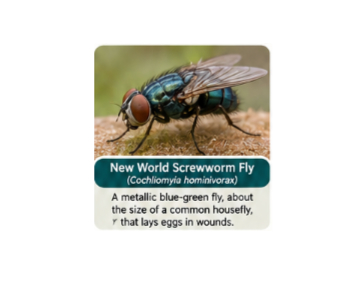
The adult fly has a metallic blue-green appearance and is roughly the size of a common housefly.
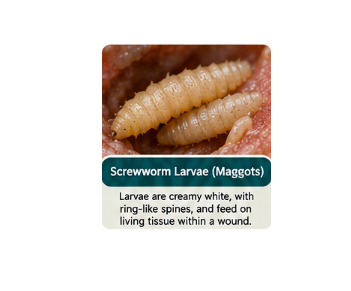
The larvae are cream-colored and have small rings of spines along their bodies. They are typically found within a wound, where they feed on living tissue.
Other flies and larvae can look similar, so it isn't possible to confirm New World screwworm simply by comparing what you see to a picture.
If you notice maggots in a wound, please have your pet examined by a veterinarian right away.
How Quickly Can an Infestation Develop?
One of the reasons New World screwworm is so concerning is how quickly an infestation can develop.
After a female fly lays her eggs, they can hatch in approximately 12–24 hours. The larvae then begin feeding on living tissue and continue growing over the next several days.
As they feed, the wound can become deeper and larger. You may notice swelling, drainage, an unpleasant odor, or signs of infection.
After approximately 5–7 days, the mature larvae leave the wound and enter the soil, where they continue developing into adult flies.
Under favorable conditions, the entire life cycle can take approximately three weeks.
Because this happens so quickly, early veterinary care is extremely important.
What Should You Be Watching For?
We recommend taking a few extra minutes each day to check your pets, especially if they spend time outdoors.
Pay attention to:
Wounds that are getting larger or don't seem to be healing
Maggots or clusters of eggs around a wound
Swelling, redness, or unusual drainage
An unpleasant odor coming from a wound
Excessive licking, scratching, or discomfort
Irritation around the ears, eyes, nose, mouth, or genital area
Changes in appetite, behavior, or activity
Don't overlook the small things. A minor scratch or irritated area may not seem concerning at first, but it is worth keeping an eye on.
If you notice maggots or a wound that is rapidly worsening, please seek veterinary care immediately. Do not attempt to remove the larvae or treat a suspected infestation at home.
What Can You Do to Help Protect Your Pets?
There are a few simple things we encourage everyone to do.
Check your pets daily. Take a good look at their skin, paws, ears, and areas that may be harder to see.
Pay attention to wounds. Even small scratches, insect bites, or irritated areas should be monitored.
Follow postoperative instructions. If your pet has recently had surgery, make sure their incision stays protected and follow the care instructions provided by your veterinarian.
Help reduce exposure to flies. Keep your pet's environment clean and address anything that may attract flies.
Call if something doesn't look right. We would much rather evaluate a wound early than have a pet develop a more serious problem.
What About Your Pet's Current Preventatives?
We've received questions about whether flea, tick, and heartworm medications can help with New World screwworm.
The FDA has conditionally approved or issued emergency authorizations for certain medications to treat New World screwworm infestations in dogs and cats. Some of these may already be familiar to pet owners because they are commonly used for flea, tick, and other parasite control.
Medications identified in NWS-related treatment guidance include:
For Dogs
Credelio Quattro-CA1 — Lotilaner, moxidectin, praziquantel, and pyrantel
Bravecto Chews — Fluralaner
NexGard — Afoxolaner
Simparica Trio — Sarolaner, moxidectin, and pyrantel
For Cats
Credelio CAT — Lotilaner
NexGard COMBO — Esafoxolaner, eprinomectin, and praziquantel
These products have different indications, and their authorization status for New World screwworm may differ. Not every formulation or package of a brand is necessarily authorized for the same use.
At Coronado Veterinary Hospital, we currently carry Credelio Quattro for dogs. Depending on your pet's current prevention program, medical history, and individual needs, our veterinarians can help determine which medication may be appropriate.
For dogs already receiving ProHeart or another heartworm preventative, Bravecto may be an option without changing their current heartworm prevention program.
One important distinction we want pet owners to understand is that a medication authorized to treat New World screwworm does not automatically mean it is approved to prevent an infestation.
We don't recommend starting, stopping, or changing your pet's medications without first speaking with your veterinarian. Even pets receiving an appropriate medication should still be checked regularly for wounds.
What About Traveling With Your Pet?
This is another area where we know there has been some confusion, especially for clients who regularly travel to Tucson or have upcoming trips planned.
Following confirmed cases, the Arizona Department of Agriculture established designated areas known as Infested Zones (IZ) around affected locations.
These zones generally extend approximately 12.4 miles (20 kilometers) around a confirmed detection.
Animals located within an active Infested Zone may have additional requirements before they can leave that area.
The important thing to remember is that travel restrictions are based on the location of the Infested Zone, not simply which county you live in or which county you are traveling to.
Not everyone in Cochise County is necessarily located within an active Infested Zone.
Traveling Within Arizona With Your Dog or Cat
We contacted the Arizona State Veterinarian's Office directly to clarify the requirements for dogs and cats traveling from an active New World screwworm Infested Zone to another location within Arizona.
The good news is that the required inspection can be performed by an Arizona-licensed veterinarian. USDA accreditation is not required for intrastate travel.
Pets must also have documentation showing they are currently receiving an approved preventative medication. If they are not already receiving a qualifying product, the appropriate medication can be administered at the hospital.
This is particularly important for clients traveling to Tucson for specialty appointments, advanced diagnostics, or other veterinary services.
If your pet has an upcoming appointment outside an active Infested Zone, please contact Coronado Veterinary Hospital ahead of time so we can review their current medications and help prepare for their visit.
Please remember that travel outside Arizona or internationally will have additional requirements.
Traveling Outside Arizona
If you are planning to travel to another state with your pet, additional requirements may apply when departing an active Infested Zone.
These may include an examination by a USDA-accredited veterinarian, documentation of an appropriate New World screwworm treatment, a Pre-Movement Inspection Certificate, and an Interstate Certificate of Veterinary Inspection, commonly called a health certificate.
Your destination state may have its own requirements as well.
If you have travel plans, please contact us ahead of time so we can discuss what may be needed.
Traveling to Mexico With Your Pet
We know many families in our area travel to Mexico, whether for vacations, family visits, or even a short trip across the border.
International travel involves more than just New World screwworm requirements, so it is important to plan ahead.
For dogs traveling into Mexico:
Mexico currently requires a New World screwworm inspection certificate issued by a USDA-accredited veterinarian within five days before entry. Dogs are also subject to inspection upon arrival.
For dogs returning to the United States:
Dogs returning from Mexico must meet USDA screwworm inspection requirements, including an examination and certification by an authorized veterinarian in Mexico within five days before returning. CDC dog-entry requirements also apply, including age, microchip identification, and other eligibility rules.
For cats traveling into Mexico:
Mexico does not currently require a New World screwworm inspection certificate for routine pet cat entry, but cats are subject to inspection upon arrival.
For cats returning to the United States:
The CDC does not currently require a federal rabies vaccination certificate for cats entering the United States. However, Arizona and other states may have additional requirements. We recommend keeping your cat's rabies vaccination current and carrying documentation.
Please keep in mind that these are highlights of the New World screwworm requirements, not a complete list of everything needed to travel with your pet.
Before leaving, make sure you have confirmed all applicable vaccination, identification, health certificate, destination, and return-entry requirements.
If you are traveling from an active Infested Zone, Arizona's movement restrictions may also apply.
We're Keeping a Close Eye on the Situation
Our veterinarians and team are continuing to follow updates from the Arizona Department of Agriculture, USDA, and FDA as more information becomes available.
We are available to examine pets with suspicious wounds, discuss medication options, and help clients understand veterinary examination and documentation requirements associated with travel.
We also encourage you to check the official resources below, especially if you have upcoming travel plans. Requirements may change as the situation develops.
Have Questions? Give Us a Call.
We know this is a lot of information, especially when it involves something new to our community.
For now, the most important things you can do are check your pets regularly, pay attention to wounds, and seek veterinary care promptly if something doesn't look right.
If you have questions about your pet's current medications, a wound you are concerned about, or travel plans, please give us a call. We're happy to help you work through what your pet may need.
Coronado Veterinary Hospital
Monday–Friday: 7:00 AM–6:00 PM
Saturday: 8:00 AM–3:00 PM
Additional Resources
For the most current information, we encourage you to visit:
Arizona Department of Agriculture – New World Screwworm
https://agriculture.az.gov/divisions/animal-services/state-veterinarians-office/new-world-screwworm
FDA – New World Screwworm Information
https://www.fda.gov/animal-veterinary/safety-health/new-world-screwworm-information-veterinarians
USDA – Traveling to Mexico With Pets
https://www.aphis.usda.gov/pet-travel/us-to-another-country-export/pet-travel-us-mexico
USDA – Bringing Dogs Into the United States
https://www.aphis.usda.gov/pet-travel/another-country-to-us-import/dogs
Information prepared November 5, 2026. New World screwworm case locations, Infested Zones, medication authorizations, and travel requirements may change. Please confirm current guidance before traveling.